


Working Capital Optimization: Why Transparency Alone Is Not Enough


Many mid-market companies know that too much capital is tied up in their processes. They know it because they see it in the numbers: in the Cash Conversion Cycle, in Days Sales Outstanding, in inventory that isn't turning as planned. What they don't know is where exactly the problem originates, why it keeps recurring, and how to fix it for good.
That is the difference between looking at metrics and understanding the processes behind them. And this is precisely where the real conversation about Working Capital Optimization (WCO) begins.
The Problem Is Not the Analysis. It Is What Comes After.
Process Mining and data visualization have helped many companies gain a better understanding of their processes in recent years. Transparency is more valuable than flying blind. But transparency alone does not free up capital.
The data confirms this: According to Deloitte, the core challenge for finance leaders is that liquidity improvements are often driven by short-term measures rather than structural change. Finance leaders cannot rely solely on strong revenue and profit figures – they need structural Working Capital Optimization that holds up under pressure over the long term (Deloitte Working Capital Roundup 2025).
The reason is not a lack of willingness to optimize. It is that the "why" often remains in the dark. Companies can see that capital is tied up, but not where exactly it originates or which processes are responsible. Without this understanding, measures remain isolated and fall short.
Three Bottlenecks That Tie Up Capital
1. Interfaces Without Feedback
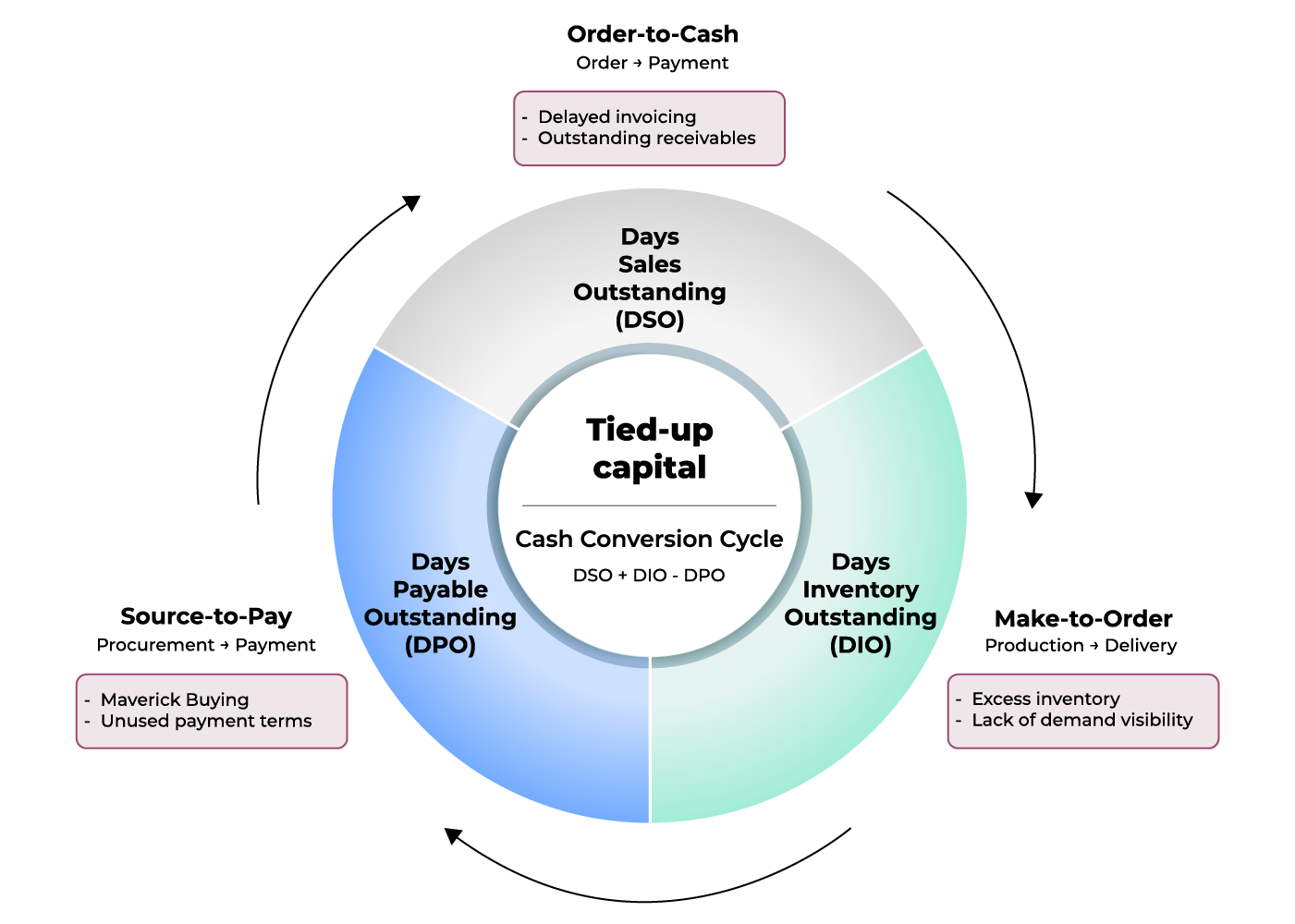
Processes such as Order-to-Cash, Source-to-Pay, or Make-to-Order appear clearly structured on paper. In reality, those same processes exhibit dozens of variants, manual interventions, system breaks, and rework that no one explicitly ordered but everyone quietly accepts. Metrics like DSO, DIO, and DPO reveal trends, but not causes. What is missing is the picture beneath: where cash actually gets stuck and why.
Two real-world examples make this tangible. When a customer order is cancelled, the procurement processes already triggered continue to run unimpeded in many ERP systems. Goods arrive, are stored, and tie up capital for months – because sales and procurement operate in silos. A similar pattern applies to crisis parameters in master data: safety stock levels manually increased during the supply chain crisis have in many cases never been reset. The crisis is over, the parameters remain, and planning is effectively running into a wall of outdated data.
2. Improvements That Fizzle Out
WCO initiatives often start with a clear goal and early measurable results. Six months later, many companies have reverted to old patterns. The reason: improvements were implemented in isolation rather than embedded into continuous operational management. Without a mechanism that detects deviations and automatically course-corrects, hard-won gains are lost.
3. Operational Overhead Costs Time
The bottleneck in most finance processes is not the analysis itself. It is the operational overhead surrounding it: consolidating data from disparate systems, aligning formats, obtaining approvals, preparing outputs for different stakeholders. All of this costs time. And time is the most expensive resource in Working Capital Management.
All of these bottlenecks directly impact the Cash Conversion Cycle: the cycle in which capital invested flows through procurement, production, and sales until it returns as incoming payment. The following diagram shows where this cycle typically slows down.
Why Conventional Analytical Approaches Fall Short
Business Intelligence shows that a problem exists. Process Intelligence shows why it exists, where it originates in the process chain, and what actions can be taken. In its current Innovation Insight on Object-Centric Process Mining (March 2026), Gartner describes this approach as the foundation for a new generation of process analysis – one that overcomes siloed perspectives and ranks Supply Chain and Inventory Optimization as the use case with the highest expected business value.
Working Capital is a cross-functional issue. The greatest optimization potential lies precisely where Finance, Sales, SCM, Procurement, Production, and R&D intersect. No single report covers this, because the root causes emerge at the interfaces between processes – not within any individual system.
From Visibility to Autonomous Optimization
Here lies the decisive shift that many WCO approaches have yet to make: it is no longer just about making inefficiencies visible. It is about fixing them. Automation is not a new concept – what is new is the intelligence behind it. Artificial intelligence enables organizations not just to control processes based on predefined rules, but to recognize patterns, proactively identify action needs, and intervene precisely. And to do so partially autonomously, continuously, and within clear guardrails defining what an AI agent may decide independently and what must remain with the human.
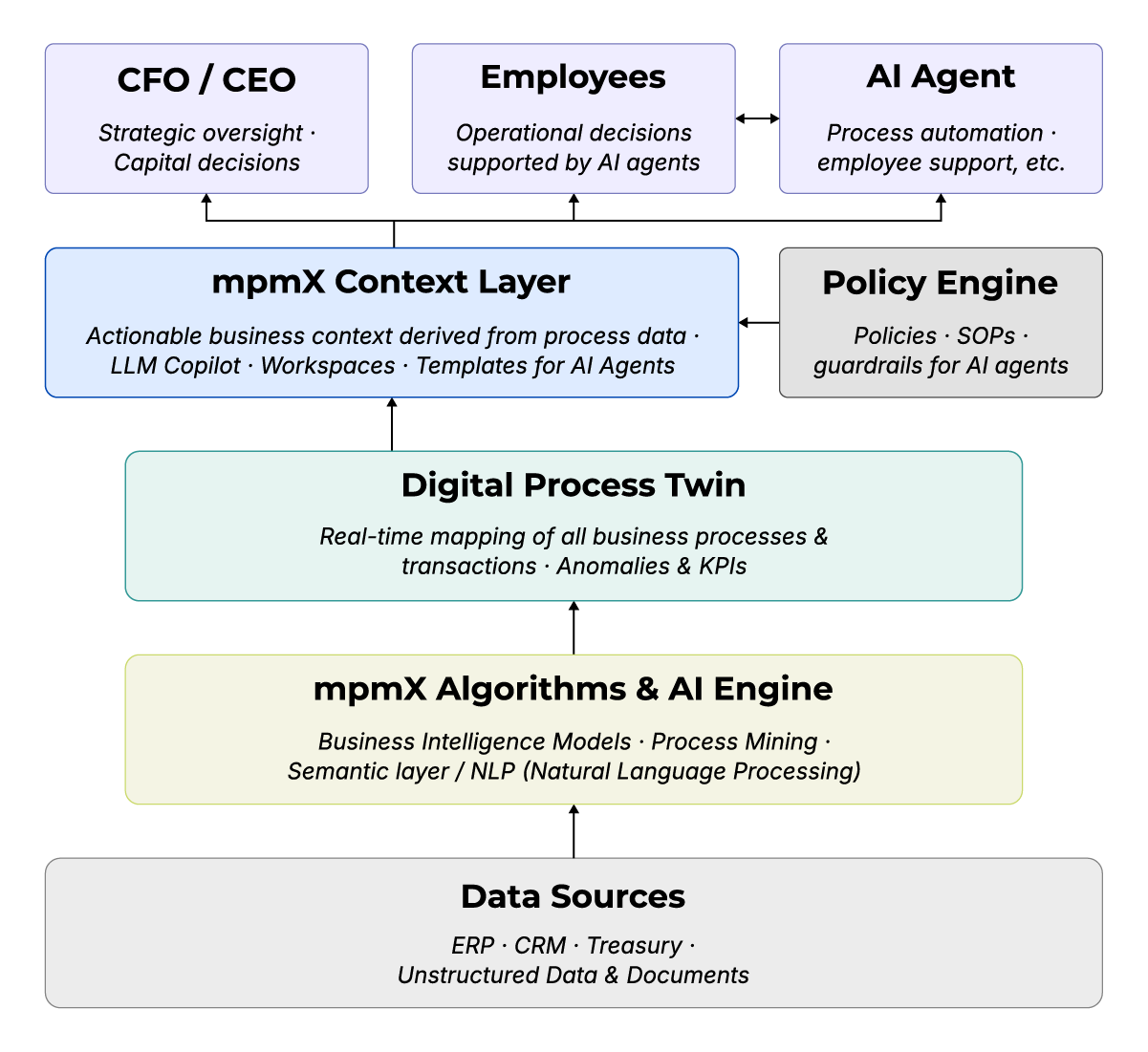
mpmX provides the foundation for this: a digital twin of business processes that does not function as a static reporting tool, but as a context layer on which AI agents can operate safely and precisely. Because AI is only as good as the context it understands. Generic language models do not know enterprise processes. They do not know what an early payment discount window is, how a dunning process works, or why a safety stock level might be too high. mpmX gives them exactly this context, so that recommendations do not remain generic but are precise and directly actionable.
The approach follows a clear three-step logic. In the first step, finance and supply chain teams can query the entire data set in natural language and receive root cause analyses in seconds, without tool expertise or waiting times. In the second step, mpmX AI enables cross-site analyses such as plant comparisons or slow-mover clusters that are simply not feasible in Excel. In the third step, AI agents take over operational control: continuously analyzing data, identifying action needs, and automatically assigning concrete tasks to the responsible person.
In concrete terms: if the system identifies that a particular activity in Order-to-Cash represents a recurring bottleneck and is well-suited for automation, it proactively suggests handing that task over to an AI agent. In the Agent Workbench – a central cockpit for managing all AI agents – the team determines which tasks run autonomously and where human decision-making remains necessary. In individual finance processes such as invoice processing or purchase order matching, AI agents can reduce cycle times by up to 90 percent, while simultaneously improving auditability and reducing compliance risk (PwC).
"Agentic AI turns Working Capital into a self-optimizing system – agents continuously sense risk and opportunity, trigger real-time interventions, and adapt decisions dynamically to unlock cash faster and reduce volatility."
(Deloitte Working Capital Roundup 2025)
Governance as a Prerequisite for Trust
Deploying AI agents on core operational processes requires one thing above all: trust. And trust does not come from technology alone, it comes from clear governance.
The CFO of the future defines which areas are fully automated, which always require a human in the loop, and which remain AI-free zones. He is no longer primarily a producer of numbers, but the architect of a system that continuously creates value.
mpmX provides the Policy Engine for this: rules, approvals, and compliance guardrails that define the boundaries within which agents may act autonomously. This gives leaders the confidence they need to deploy agentic AI not as a pilot project, but as operational reality.
What This Means in Practice
The potential is there, but largely untapped in many organizations. According to the Deloitte Working Capital Management Report Germany, only one third of German companies managed to keep their Cash-to-Cash Cycle stable or reduce it between 2022 and 2024. Smaller companies are experiencing the steepest increase in capital tied up. Despite falling inflation and interest rates, money remains expensive and external financing remains challenging.
An EY study of 114 companies in mechanical and plant engineering across the DACH region reaches a similar conclusion: currently, 101 billion euros are tied up in Working Capital, an enormous liquidity potential that companies could release through optimized processes.
A significant portion of this is not a structural problem. It is a process and governance problem. What is missing is the mechanism that continuously unlocks this potential.
Ensuring Lasting Operational Capability
Leaders do not need more dashboards. They need systems that take work off their plate, with the confidence that those systems are doing the right things, within the right framework, at the right time. Working Capital Optimization is not a one-time project. It is a continuous mechanism. And this mechanism only works when transparency, intelligence, and the ability to act come together.
If you want to know where liquidity potential is lying dormant in your processes and how an AI agent can unlock it for you, get in touch with us.
Want to go deeper into the numbers? Our WCO Whitepaper shows concretely what liquidity potential exists in manufacturing companies – and how it can be systematically unlocked.

- Deloitte USA – Working Capital Roundup 2025: https://www.deloitte.com/us/en/services/consulting/articles/working-capital-management-report.html
- Deloitte Germany – Working Capital Report 2025: https://www.deloitte.com/de/de/services/consulting-financial/research/working-capital.html
- EY Germany – DACH Industrial Manufacturing Working Capital Study 2024: https://www.ey.com/de_de/insights/strategy-transactions/vorteile-von-verbessertem-liquiditats-und-working-capital-management
- Gartner – Innovation Insight: Object-Centric Process Mining Powers Agentic Automation, Governance, and Value Realization, March 2026, ID G00829993
- BCG – The AI-First Finance Function: https://www.bcg.com/publications/2026/the-artificial-intelligence-first-finance-function
- PwC – How AI Agents Drive a New Finance Operating Model: https://www.pwc.com/us/en/tech-effect/ai-analytics/ai-agents-for-finance.html

More Articles
Dive in and discover a world where every process tells a story. Turn data into your advantage – unleash its potential with Process Mining andtransform your processes into success stories.

Value Stream Mapping with Process Mining


Toolbox automation: 4 basic tools you need to automate business processes

The hype surrounding Digital Twins – What’s behind it?
Process Mining that fits your organization

