

Settle claims faster and cut handling costs.
Claims sit in the queue, customers don't know where their case stands, and every provider works differently. mpmX flags the claims that are stuck, routes them to the right adjuster automatically, and shows you which providers actually deliver.
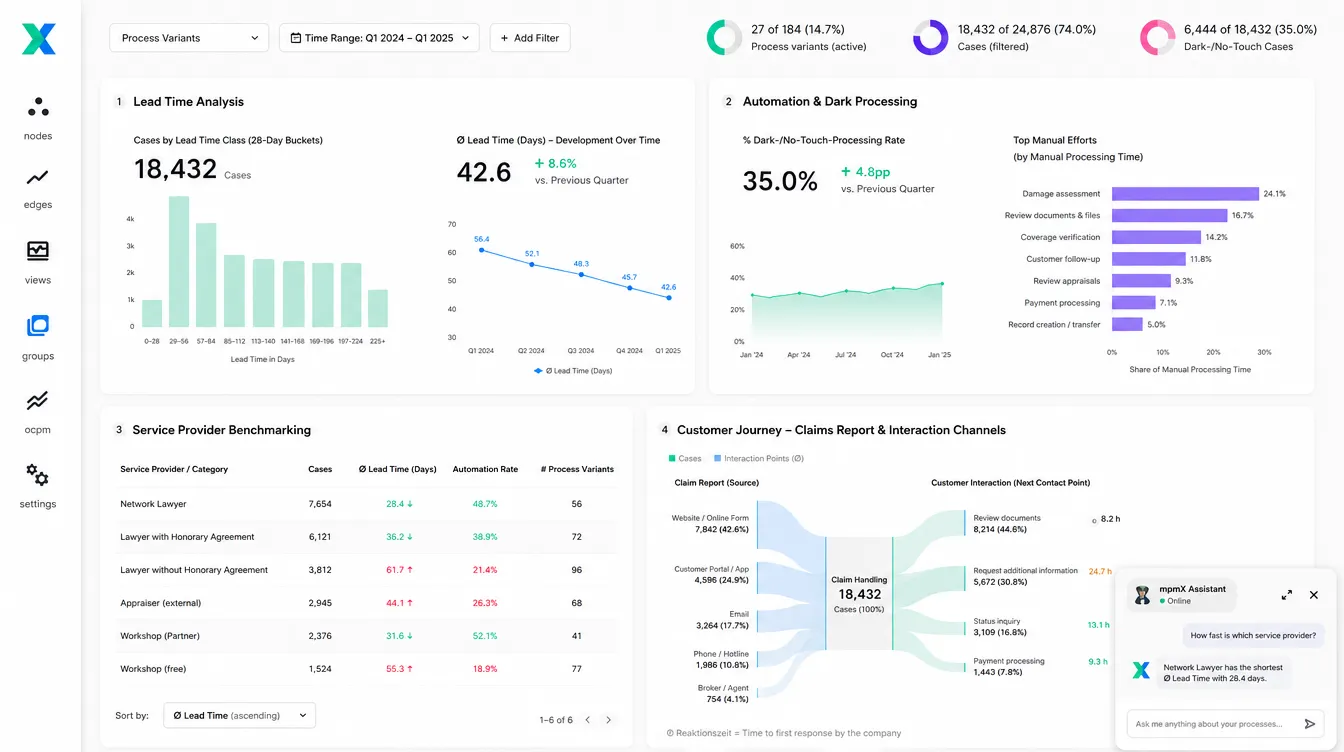

What process intelligence actually does for insurers
No projections. No estimates. Numbers from live customer projects.
-28d
One insurer doubled its fast-track settlement rate and cut processing from 35 days to 7. Less bureaucracy in the process means faster payouts and noticeably happier customers.
€1.3M
By automatically routing claims to the right specialist and cutting out rework, handling costs drop significantly. Internal costs are the lever on your combined ratio that you control yourself.
+14%
Suspicious claim patterns are flagged and prioritized automatically. That gets questionable cases to specialists sooner, instead of letting them slip through unnoticed.



Four use cases. Measurable results.
mpmX goes after the most expensive weak spots in claims handling and the customer journey with pre-built templates that deliver first results in a matter of days.
Long processing times cost customer trust and money.
Claims sit in processing, often with no one stepping in. The customer has no idea where their case stands. The longer a case drags on, the more follow-up questions and complaints it generates. With hundreds of process variants, it's almost impossible in day-to-day work to see which cases are stuck.
mpmX measures the cycle time of every single claim and automatically detects cases that are sitting too long. When a review passes six days, an agent flags the case, prioritizes it, and calculates the optimization potential on the spot. Your adjusters can see at a glance which cases are urgent and why.
- Faster payouts and, with them, happier customers.
- Fewer follow-up questions and complaints thanks to transparent processing.
- Adjusters focus on the cases that genuinely need attention.
From 35 to 7 days cycle time, fast-track rate doubled
Insurance Company, Background: in one customer project, 5,430 cases with long review times were identified, an average of 1.13 days lost per case, which works out to roughly 9% optimization potential in cycle time.
Comparison sites make switching easy. Even short delays cost you customers.
Customers interact across many channels, from comparison portals to the app to the phone. Where the journey breaks down stays invisible. Especially in long-term insurance relationships, every bit of friction nudges customers toward a cheaper provider.
mpmX brings every touchpoint into the analysis of your customer processes and shows where breaks, wait times, or dissatisfaction occur. The result is a holistic customer view across all channels, from new-customer acquisition through to claims settlement.
- Weak spots in the customer journey become visible and fixable.
- A complete customer view instead of isolated channel data.
- Targeted action to protect long-term customer relationships.
A holistic customer view across all touchpoints, with workload reduced despite rising claim volume
WGV Versicherung
Suspicious claims often slip through standard processing unnoticed.
Fraudulent claims look like normal ones at first glance. In the sheer volume of cases, suspicious patterns barely register in a manual process. Every fraudulent claim that slips through hits claims expenses directly, and with them, the combined ratio.
mpmX automatically flags suspicious patterns and deviations from the usual claims flow and prioritizes those cases for review. Suspicious claims reach specialists sooner. Clear-cut cases can be rejected automatically by an agent, with your team always able to review or reverse the decision. Geo and weather data can be layered in to gauge plausibility and volume after major events like flooding.
- Higher fraud detection with no extra manual effort.
- Lower claims expenses and a direct effect on the combined ratio.
- Clear prioritization instead of spot checks based on gut feeling.
+14% fraud detection
in customer projects
Every provider works differently. The trouble is, you can't see who's actually good.
Claims handling involves external partners like repair shops, appraisers, and law firms. Depending on the partner, the process runs completely differently. Without a shared data foundation, there's no objective way to compare which provider works quickly and efficiently and which one slows the process down.
mpmX brings all process variants together in a single point of truth and compares providers on the same metrics: cycle time, automation rate, and number of variants. That makes it clear which partners speed the process up and which relationships are worth it.
- An objective basis for selecting and managing service providers.
- Shorter cycle times by working with the most efficient partners.
- A factual basis for negotiating fee agreements.
54 days instead of 148 days; 43% automation rate instead of 9%
BGV Badische Versicherungen, network lawyers vs. external lawyers without a fee agreement

Common questions about process mining in insurance
Got questions before you book a demo? Here are the ones we hear most often.

It doesn't, in the traditional sense: mpmX comes to your data, not the other way around. The platform integrates natively with your existing infrastructure, whether that's Qlik, Salesforce, Databricks, or BigQuery, and uses your existing claims and policy systems as the source. Pre-built connectors and templates mean most of the ETL work is already configured instead of being built from scratch for every project. If you need maximum control, you can run mpmX fully on premises.
The combined ratio is the ratio of claims and cost expenses to premium income, the central profitability indicator for an insurer. You only have limited control over claims expenses themselves, but you do control your internal costs. That's exactly where process mining comes in: it lowers administrative and handling costs, helps estimate loss reserves realistically, and makes the profitability of individual products measurable. So you improve the ratio through the lever you actually control.
Yes, and that's exactly when it proves most valuable. A high number of variants is the rule in insurance, not the exception. At BGV, there were over 170,000 variants in claims handling that could no longer be tracked manually. mpmX maps that complexity automatically, pulls it together into a single data model, and makes it filterable and comparable. That transparency is where the first concrete starting points for standardization and automation come from.
Process mining shows how every single claim actually runs, not just aggregated metrics. A BI tool tells you that average cycle time has gone up. Process mining tells you exactly which cases lose the time, which service provider slows the process down, and which variants are behind it. At BGV, that meant over 170,000 process variants in a single process. And mpmX doesn't stop at showing you: cases are prioritized automatically, suspicious patterns are flagged, and repetitive tasks are automated.
A generic AI assistant only knows what you type into it. It doesn't know that a specific claim deviates from your other 170,000 process variants, or that its pattern matches past fraud cases. mpmX gives an AI agent exactly that process context: what happened, in what order, and how it differs from the normal claims flow. Without that context, an agent can only discuss your process. With it, an agent can act on your claims data, flagging a suspicious case or rejecting a clear-cut one automatically, always with a specialist able to step in.
Your data never leaves your infrastructure. mpmX integrates natively with your existing environment and automatically inherits its security and governance structures. Especially for sensitive data like health or claims information, mpmX can be deployed fully on premises and, if needed, offline. Personal data about policyholders can be anonymized on request. Violations of internal rules or regulatory deviations also become visible automatically.
Time-to-value is particularly short with mpmX. Pre-built templates mean no process has to be built from scratch. At the same time, mpmX integrates natively into your existing infrastructure, which removes the need for costly data preparation. Because mpmX doesn't just analyze, it turns identified issues directly into concrete actions, such as automated AI workflows or alerts, the investment pays off correspondingly fast. Tangible results with your own data are typically available within the first four weeks.
Start today with mpmX or talk to an expert
Real businesses solving real problems. Watch how mpmX uncovers hidden inefficiencies and turns complex data into actionable intelligence.








Digitalization in the Insurance Industry

Cloud vs. on-prem in the insurance industry

Difference between OCPM and Process Mining
Process Mining that fits your organization
Discover even more resources
