


The Bank’s Digital Twin: Process Intelligence as the Engine for Customer Experience & Compliance



Banks Need a New Way to Understand Processes
A bank’s loan calculator at the starting point of the customer journey: 1,000 interested prospects. After numerous additional clicks, submitted documents, and identity checks, at completion: 50 customers.
Where, when, and why are prospects dropping out?
Banks are under enormous pressure to change: customer expectations continue to rise, regulatory requirements are increasing, and at the same time institutions are expected to become more efficient. Neobanks are capturing ever larger market shares in both new and existing customer business. Yet many management and reporting tools still provide only isolated snapshots of reality. And on top of that, AI is expected to work as well.
What if you had full transparency into what is actually happening? Welcome to a new discipline in banking: Process Intelligence.
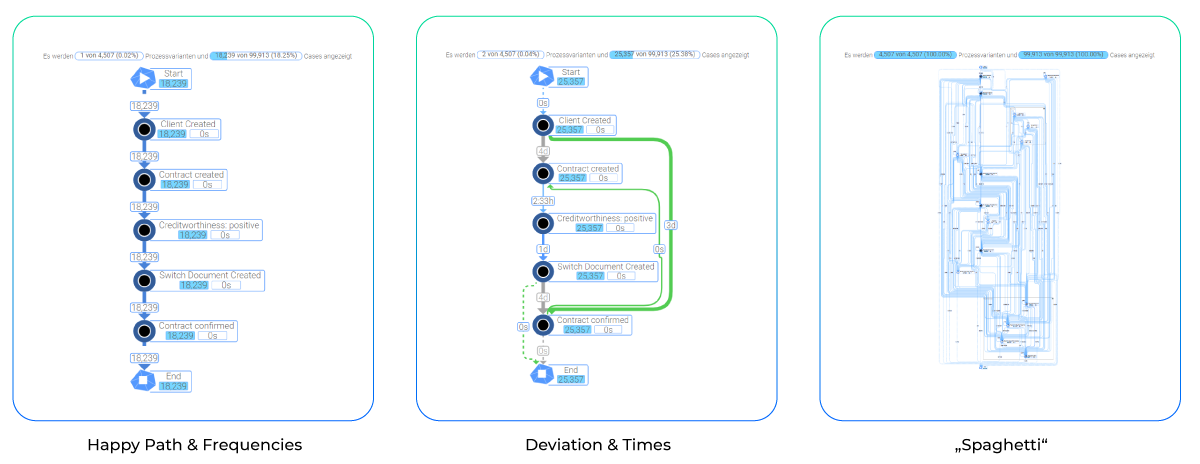
Process Intelligence creates true, data-driven process transparency and reveals clear optimization potential in critical business processes.
– Fabian T., Lead Process Mining Consultant | msg for banking
Only those who truly understand their as-is processes can sustainably improve the customer journey.
KYC as the Starting Point of the Customer Experience
The Know Your Customer (KYC) process is far more than a regulatory obligation. It is often the moment where a prospect either builds trust or abandons the journey altogether. This is precisely why this process deserves special attention: everything that later determines customer satisfaction, efficiency, and conversion becomes visible here for the first time.
The mpmX Customer Journey App, developed in cooperation with msg for banking, makes the entire customer journey transparent – from the initial touchpoint to the first credit product. The journey follows clearly defined, systemically captured steps: The customer’s first interaction with the bank, structured data capture and address validation, identity verification via WebID or ID recognition, PEP and sanctions list screening, credit scoring or SCHUFA checks, account opening, and the subsequent loan application. What sounds like a clean and structured flow in theory reveals a much more complex reality in practice. The data speaks clearly: Conversion rates of around 5% across all onboarding processes are not uncommon in banking. This is not just lost potential it has an immediate financial impact. Projects by mpmX and msg show that it is entirely realistic for a bank to lose €500,000 per year in value because customers abandon the process early and do not complete onboarding. Using the socio-demographic analysis capabilities of the mpmX Customer Journey App, banks can additionally identify which target groups are most affected and where focused improvements would deliver immediate impact. This turns the KYC process into the foundation of a consistently data-driven customer experience: it not only shows where customers drop out, but also provides the key to lowering entry barriers, building trust, and sustainably improving the journey.
“With a single glance, we can see where and why customers drop off – and which segments are most affected.”
– Process Mining Consultant | msg for banking
From Cases to Relationships: Object-Centric Process Mining
Traditional process mining shows how a process is executed as a linear sequence. Real customer experiences, however, are rarely linear. They branch, jump, overlap, and emerge from a multitude of parallel interactions. This is exactly where Object-Centric Process Mining (OCPM) comes into play. OCPM no longer focuses solely on the process being analyzed, it puts the customer at the center. All relevant objects, such as tickets, accounts, checks, or verifications, are modeled as individual, measurable entities and linked together. This creates an entirely new perspective on subprocesses and their interdependencies: a customer journey that becomes visible as a connected system. Analysis immediately reveals how tightly decisions, checks, and payments are intertwined. A KYC check impacts account opening; delays in PEP or sanctions screening affect credit assessment; parallel ticket processing changes throughput times. With OCPM, all of these relationships and dependencies become transparent, structured, and traceable – no longer hidden behind system or departmental boundaries.
As one solution engineer aptly put it:
With OCPM, we are finally able to understand how decisions, checks, and payments are truly connected.
This makes Object-Centric Process Mining the foundation of the bank’s digital twin: it maps real, dynamic process relationships and uses the customer as the central reference point. It also demonstrates that compliance and customer experience are not opposites. With the right data foundation, both can be optimized simultaneously – a competitive advantage that traditional, linear process views cannot deliver.
Process Intelligence: The Foundation of Every Workflow Optimization
Many banks are currently planning automation or workflow initiatives. But workflows always represent a theoretical target model. Reality almost always looks different: parallel checks, variants, rework loops, manual exceptions, and expert decisions. Without an analysis of the as-is processes, automation becomes ineffective and purposeless. Process models remain assumptions.
Process Intelligence emerges where process mining forms the first step:
- It visualizes all real process variants
- It identifies bottlenecks and loops
- It detects automation steps prone to errors
- It reveals which decisions and dependencies truly matter
Only on this data foundation can workflows be meaningfully designed, automated, or harmonized. Automation becomes more precise, more reliable, and economically viable. In short: Process mining delivers the intelligence automation needs. That is Process Intelligence.
The Bank as a Digital Twin. The Customer at the Center.
Imagine a bank where every process – from the first customer interaction through KYC and onboarding to lending, payments, service, and settlement – is no longer a black box but a visible reality. A bank that understands every step, detects every deviation, identifies every bottleneck early, and automatically uncovers optimization potential.
A bank where processes do not exist in isolation, but come together as a digital twin: a living representation of the organization in which customer journey, compliance, risk, and efficiency interact in real time.
Through the partnership between mpmX and msg for banking, the Customer Journey App provides the ideal project accelerator and starting point for banking organizations. With more than 10 immediately usable use-case dashboards, over 40 banking-specific KPIs, a preconfigured data model, and msg’s business app sheets tailored to banking processes, we deliver a robust view of your customer journey, KYC processes, and all related workflows in a very short time.
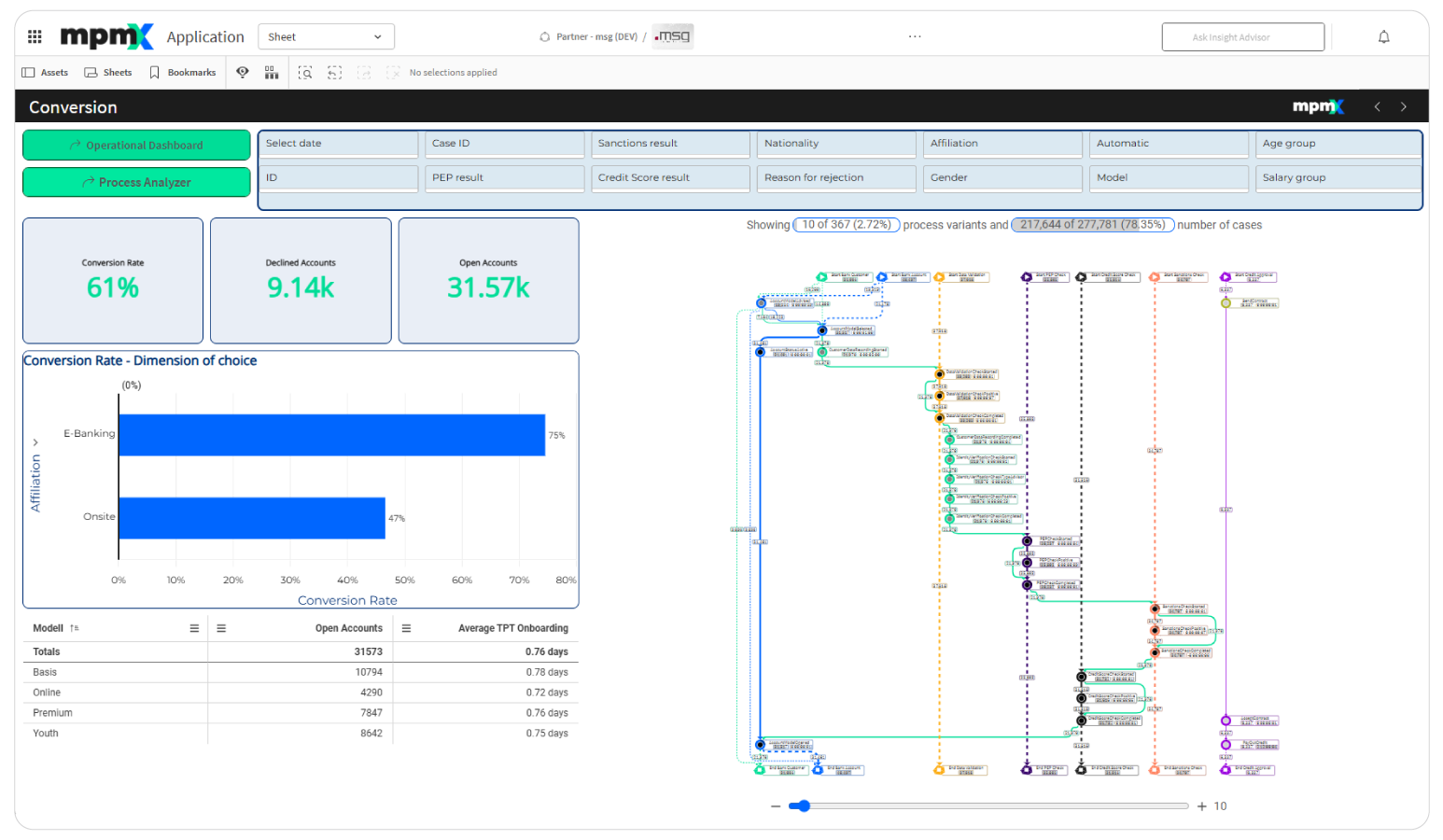
Results from real customer projects speak for themselves: significantly higher conversion rates, reduced manual rework, eliminated compliance risks, and cost effects in the five- to seven-figure range – often within just a few weeks. Now is the right time to discover the potential hidden in your processes.
Authors: Kam Sandhu (mpmX), Fabian Trauner (.msg), Tobias Bromme (.msg)

More Articles
Dive in and discover a world where every process tells a story. Turn data into your advantage – unleash its potential with Process Mining andtransform your processes into success stories.

When is Process Mining useful?


Value Stream Mapping with Process Mining

Toolbox automation: 4 basic tools you need to automate business processes
Process Mining that fits your organization

