

How process transparency and automation improve service for insured members.









Patient Transport and Respite Care: How AOK Rheinland/Hamburg Is Advancing Its Processes with mpmX
Demographic change, skills shortages, and a steadily growing number of benefit applications are putting Germany's statutory health and long-term care insurance under increasing pressure. AOK Rheinland/Hamburg shows with mpmX that targeted process improvements can absorb part of that pressure. Where experience and occasional one-off analyses used to steer processes, mpmX now delivers reliable figures. Two everyday processes, patient transport costs and respite care, show the value in concrete terms.
Reliable service as demands grow
The starting point affects the entire statutory health insurance system: insured members expect their requests to be handled quickly and reliably, and those expectations keep rising. At the same time, demographic change is increasing both the need for benefits and the demands on claims processing.
For AOK Rheinland/Hamburg, what matters is offering insured members a high standard of service even under these conditions. The growing volume of applications is largely beyond its control. How efficient and digital its processes are is not. That requires understanding how the processes actually run today and where the room for improvement lies.
When the target process and reality diverge
On paper, the processes were cleanly documented. In practice, the picture looked different. What actually happened, such as loops, waiting times, and exceptions, was not always fully visible. Deviations from the target process (the process as designed) were often hard to uncover and required manual analyses, extensive coordination, and additional interviews with employees.
This led to four main challenges:
- Handling times: For certain case types or process variants, handling took longer, and agreed service targets were occasionally missed.
- End-to-end view: Teams had good insight into their own areas of responsibility. How individual steps interacted with upstream and downstream steps, however, was not always immediately clear.
- Scattered data: Relevant information sat in different modules of oscare®, the core software for statutory health insurers, and in external sources. It was only occasionally brought together.
- Process context for KPIs: Existing key performance indicators (KPIs) showed whether targets were met but said little about why deviations occurred.
As a result, key questions about root causes, such as "Why do some cases take longer?", could not always be answered right away. Deeper analyses were possible, but they took extra time and resources because the existing metrics did not consistently capture the actual process flow in the necessary detail.
"With mpmX, we gain a level of transparency into how our processes actually run that was not possible at this level of detail before. This allows us to identify improvement potential more precisely and to develop our processes further in a data-driven, efficient, and future-proof way."
Lara Smitmans, Organizational Development Specialist, Corporate Development, AOK Rheinland/Hamburg
Clarity on processes and benchmarking across AOKs
With mpmX, the actual as-is processes become visible, not just what the target-process documentation says. Today, process and module owners have access to the implemented business processes and dashboards, just like the analysts and controllers in every department.
In their daily work, teams use this to compare target and as-is processes, uncover potential for automation, standardization, and optimization, and compare processes across organizational units and even across AOKs. This is where the second perspective comes in: that of AOK Systems, the software provider behind oscare®, and the advisory and process lead for mpmX within the AOK group.
The nationwide process benchmark is particularly valuable because it shows which AOK runs a given process most efficiently. That process becomes the template for standardization that can be rolled out across all AOKs, provided the comparison is fair: same time period, same KPIs, and standardized dashboards.

Use case patient transport costs: the digital truffle hog
Cycle time down from 12 to 5 days. Automation up from 0 to 25.64%. Around 880 working hours saved per year.
The patient transport process delivered the first concrete proof. Statutory health insurers reimburse medically necessary trips, for example to and from a hospital. The process is marked by a high and rising volume of applications, long cycle times, and a labor-intensive manual workflow, which meant long waits for insured members.
The goal was to optimize the workflow and automate more of it. The lever was the electronic prescription for patient transport (eVO), combined with APD (automated process data processing) for straight-through processing, meaning cases are handled fully automatically without manual intervention. mpmX accompanied the rollout of the digital process and showed exactly where things were still getting stuck and how the improvements were taking effect.
The resulting transparency made it possible to take precise rather than one-size-fits-all measures: fine-tuning the eVO rule sets, targeted outreach to prescribers and to KV Nordrhein (the regional association of statutory health insurance physicians), and expanding straight-through processing via the APD console.
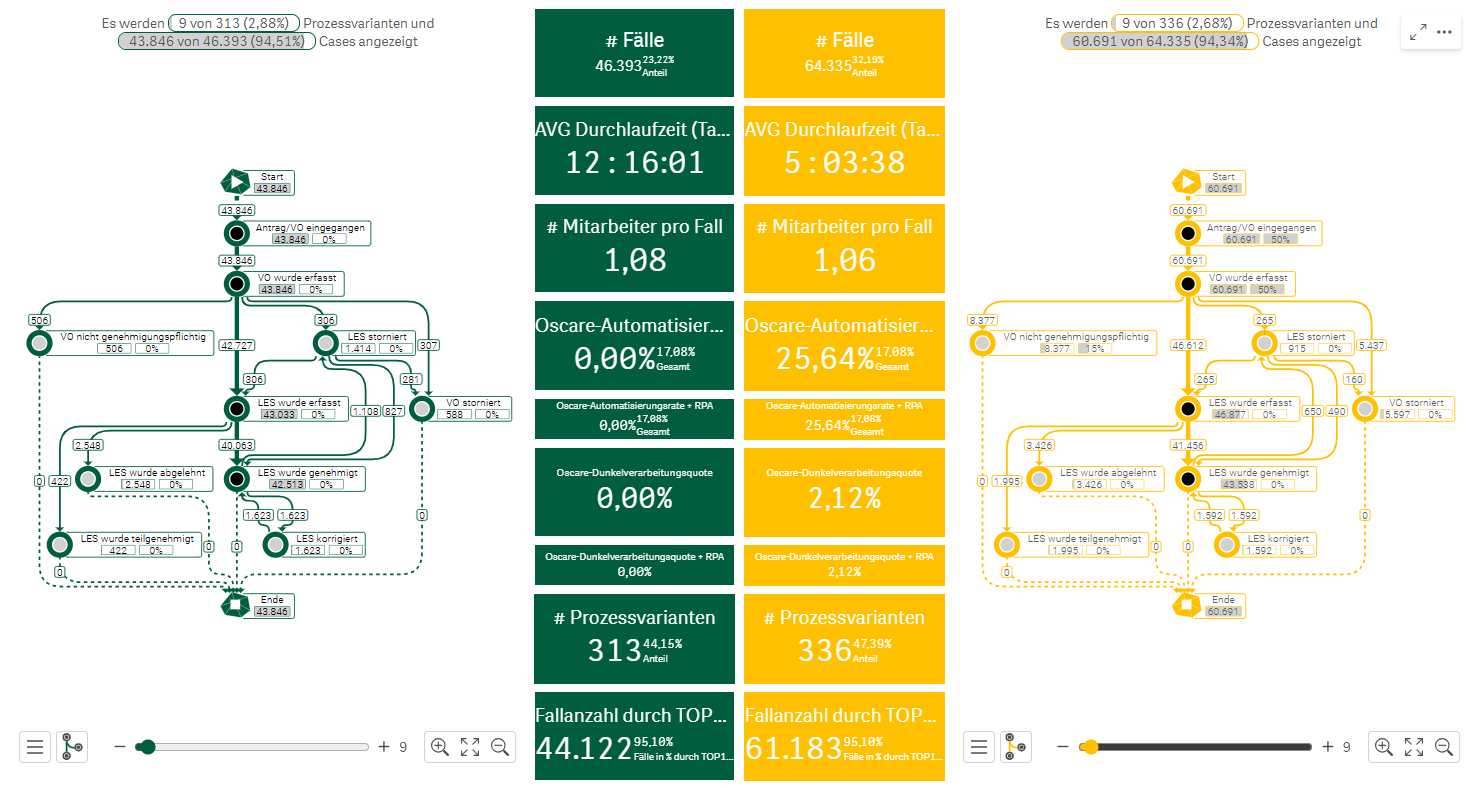
Dashboard figures
- Automation rate: 0.00% to 25.64%
- Avg. cycle time: approx. 12 days to 5 days
- Number of cases: 46,393 to 64,335
- Savings: around 880 working hours per year

Use case respite care: improving digital services measurably
Cycle time more than halved: 123 to 57 days. Automation up from 24.67 to 34.71%.
The second use case shows how the use of digital services can be tracked with data and developed in a targeted way. Respite care is a long-term care insurance benefit that covers replacement care when a family caregiver is temporarily unavailable, for example due to vacation or illness. The project focused on digitizing the application and reimbursement process: straight-through processing via an online application form (web dialog), combined with a software bot and an APD process.
With mpmX, the use of the web dialog and the effects of the digitization measures could be traced in a before-and-after comparison. The analysis revealed differences between user groups.
mpmX showed how well insured members are adopting the digital services and where these services can be developed further.
On this basis, AOK Rheinland/Hamburg refined how it guides insured members to the right application channel and strengthened the digital route with a user-centered web dialog that makes applying easier. mpmX continuously shows how usage is developing and how further measures are working.
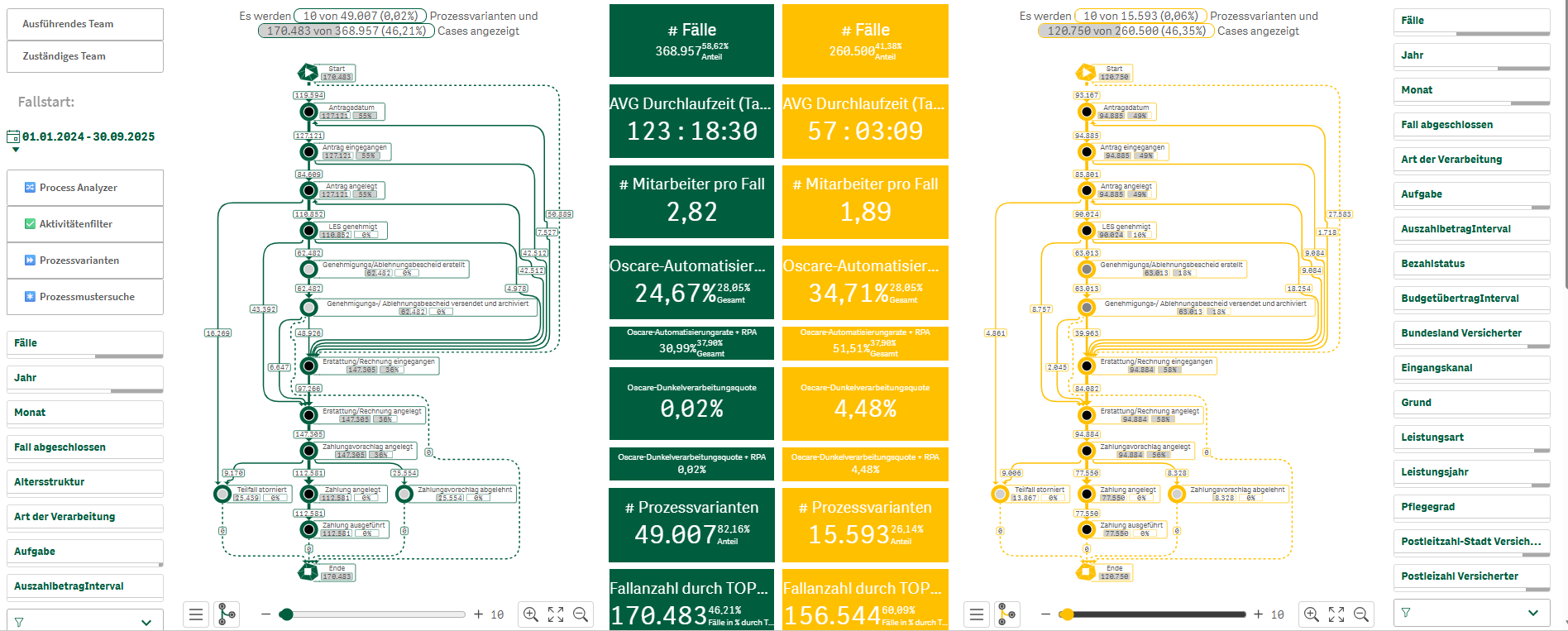
Dashboard figures
- oscare® automation rate: 24.67% to 34.71%
- Avg. cycle time: approx. 123 days to 57 days
What mpmX changed
Across both use cases, mpmX helped AOK Rheinland/Hamburg better understand the causes of process deviations, systematically identify improvement potential, and trace the impact of implemented measures with data, above all in three areas:
- Fewer manual tasks and shorter cycle times
- Higher rates of automation and straight-through processing
- Better quality in the application process and in the underlying data
This created a reliable data foundation for deriving targeted improvements and continuously checking their impact after implementation. In daily work, the value shows mainly in faster data analysis and preparation. At the same time, the shared data foundation strengthens employees' understanding of the processes and makes it easier to exchange ideas on processes and best practices across departments.
From AOK Systems' perspective, there is also a second lever: comparability between AOKs and best practices that can be transferred nationwide.

How a shared data foundation strengthens collaboration
One major effect shows in collaboration. Where different perspectives and assessments used to collide, mpmX now provides a shared, data-based foundation: improvement potential becomes visible, and discussions become more focused. mpmX helps test assumptions against data and put them into context. That strengthens the trust-based collaboration between AOK Systems and the individual AOKs.
Looking ahead: AI on a solid foundation
mpmX has created more than transparency: a digital twin of the processes, a living model of how they actually run, and with it the context that successful use of AI depends on.
AOK has a clear picture of where this is heading. Instead of searching for anomalies in the as-is process with considerable effort, the system is meant to detect them in real time, recommend actions, or resolve them directly.
AOK Systems is supporting the next steps: a locally hosted large language model (LLM) stays within the regulatory framework. Because it is integrated directly into mpmX, data governance and data protection remain fully in AOK's hands.
"Going forward, the key will be using AI to tap further potential for efficiency and optimization in statutory health insurance processes."
Kevin Klinkhammer, Data Engineer, AOK Systems

More Case Studies
Dozens of companies use mpmX to make sense of their organization and continuously improve their processes. From mid-sized companies to big multinationals.


Process Mining that fits your organization

