


Context Engineering for the Enterprise: Why AI Agents Need a Context Layer


AI models are improving faster than companies can put them to work. The bottleneck is rarely the model. It’s the context. What matters is which information an AI agent sees for a given task, whether that information is current, and whether the agent reads it correctly. Today, agents mostly get documents and metrics. Company knowledge comes from a company brain, the meaning of the data from a semantic layer and an ontology. What’s usually missing is process context. The agent doesn’t know where a case stands, how it got there, or what’s likely to happen next. It sees a snapshot, not a sequence. A context layer that brings all three types of context together closes that gap for every agent in the company.
What is context engineering?
Context engineering is the discipline of deciding which information an AI model or AI agent has available for a task, including data, definitions, rules, documents, tools, and memory. Prompt engineering crafts the individual instruction. Context engineering shapes the entire information environment the model works in. In an enterprise, that turns it into an architecture question, because context has to be connected across ERP, CRM, data platform, and documents, kept current, and delivered in line with access permissions.
The term took hold in June 2025. Shopify CEO Tobi Lütke described context engineering as “the art of providing all the context for the task to be plausibly solvable by the LLM,” and Andrej Karpathy backed the term.1 The first guides, including one from Anthropic, were written for developers and focused on how to fill a model’s context window.2 In 2026, companies are asking the same question at enterprise scale.
What’s the difference between context engineering and a context layer?
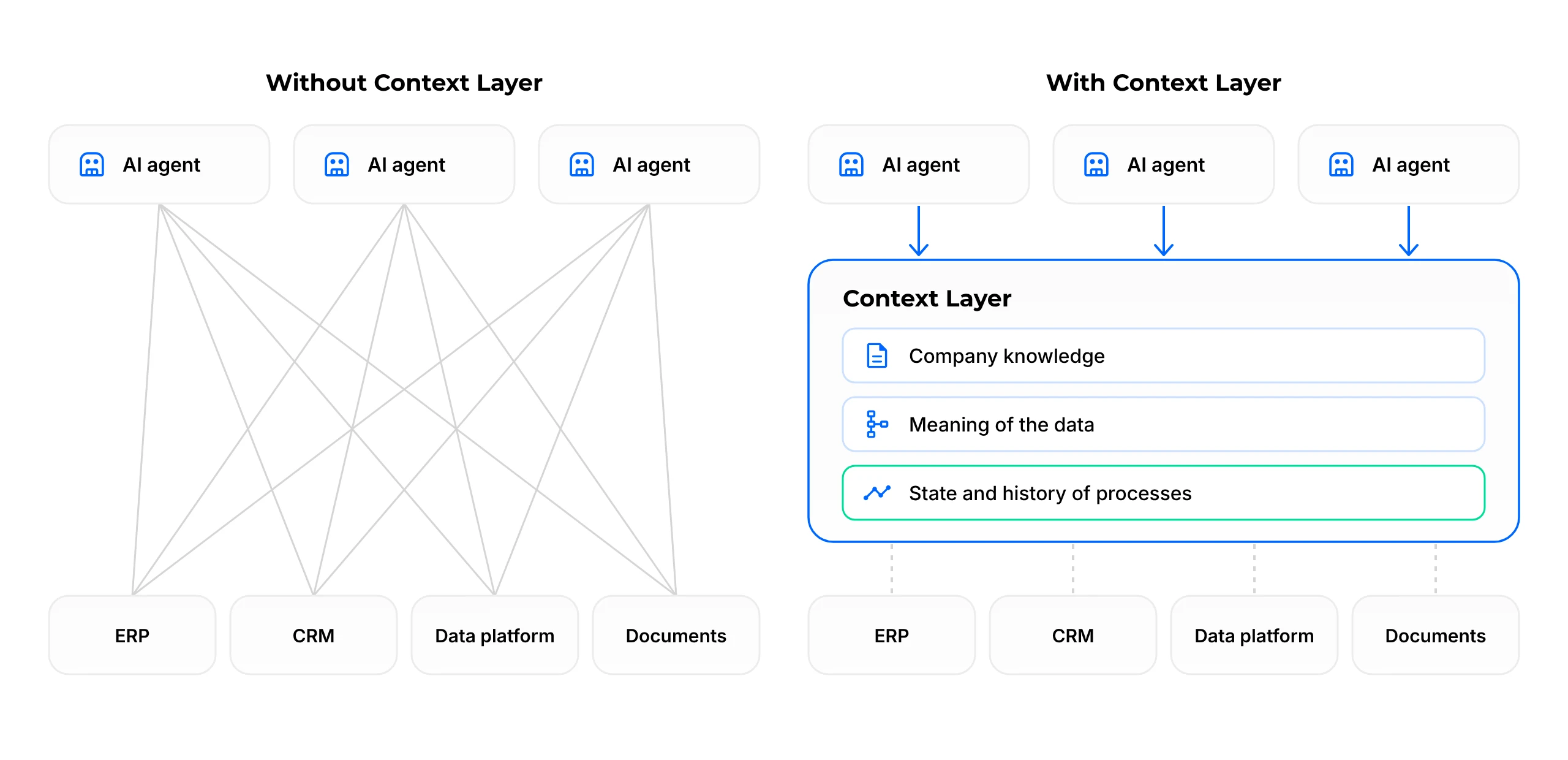
Context engineering is the discipline of selecting and preparing context for an AI task. A context layer, often called an enterprise context layer, is the shared infrastructure that discipline runs on inside a company. It gives every AI agent, copilot, and analytics tool the same vetted business context. That includes company knowledge from documents and policies, the meaning of the data from a semantic layer and an ontology, and, in broader definitions, the current state of business processes. Context engineering answers what an agent needs for a task. The context layer makes sure it’s reliably there.
You see the difference in day-to-day work. Without a context layer, every team, every agent, and every use case assembles its own context. Definitions drift apart, rules get maintained twice, and nobody can say what an agent based its decision on. With a context layer, context is defined once, governed centrally, and used by everyone.
How far a context layer reaches is still up for debate. Gartner advises data and analytics leaders to build a context layer as a core part of their infrastructure and puts semantics at the center, meaning what the data means and how it relates.3 Data catalog and data platform vendors usually take a context layer to mean approved business terms, metadata, and ontologies. Forrester takes a broader view and calls the context layer “the next evolution of semantic layers and knowledge graphs.” In its reading, it’s a living model of the enterprise that captures processes alongside data, terms, and policies, and continuously takes in events, decisions, and outcomes.4
This article takes the broader view. AI agents are expected to make recommendations and step into workflows. For that, knowing what the data means isn’t enough. They also need to know where a case stands right now.
Why do AI agents fail on context rather than on the model?
Gartner expects more than 40% of agentic AI projects to be canceled by the end of 2027 due to escalating costs, unclear business value, or inadequate risk controls.5 A simple case shows what that looks like in practice.
An AI agent is asked how reliably a customer pays. It finds the customer in the CRM, the ERP, and the accounting system under three different IDs. Sales measures late payment from the due date, finance from the invoice date. The agreed payment terms sit in a master agreement no system can access. And whether two of this customer’s invoices are currently in dispute, or how the customer actually paid last year, isn’t in any single table. It only shows up in how cases unfolded across several systems. An agent that only sees tables has to guess these connections, and it guesses with the same confidence it has when it’s right.
More data doesn’t solve the problem. In 2025, Chroma Research tested 18 language models. As input length grew, their performance became less reliable, even on simple tasks.6 What counts is that an agent gets the right information with the right meaning.
What does missing context cost?
Missing context costs money in two places. The first is the build. Without a shared context layer, every use case builds its own context. Each team connects the systems again, defines terms and metrics, and codifies rules that already exist elsewhere in the company. With every new use case, that effort grows instead of shrinking.
The second is operations. An agent without vetted context has to work it out again with every request. It searches tables, guesses at joins, calculates metrics on its own, and gets the applicable rules handed to it in the prompt. Every request burns tokens and compute, and the result is still uncertain.
A context layer addresses both. Context is built once, every new use case reuses it, and agents query it instead of reconstructing it. Gartner predicts that by 2027, organizations that prioritize semantics in AI-ready data will increase the accuracy of agentic AI by up to 80% and reduce costs by up to 60%. “Context with semantic coherence will become a cost-control and trust strategy, not a nice-to-have,” says Rita Sallam, Distinguished VP Analyst at Gartner.3
What types of context does an AI agent need?
An AI agent that’s supposed to work reliably in an enterprise needs three types of context. Each answers a different question and comes from different sources.
| Context type | Key question | Source | Typical implementation |
|---|---|---|---|
| Company knowledge | What applies? | Policies, contracts, SOPs, process descriptions | Knowledge bases, RAG, company brain |
| Meaning | What is what, how does it connect, how is it calculated? | Master data, metric definitions, business terms | Semantic layer, ontology, knowledge graph |
| State and history | Where does a case stand, how did it get there, what’s normal? | Event data from operational systems | Process mining, digital process twin |
Many approaches, including most definitions of the context layer, mainly cover the first two. That makes sense, since no agent works reliably without consistent terms and rules. But for agents that are supposed to make recommendations or take action, it falls short. They need to know what’s happening right now.
How do prompt engineering, RAG, MCP, and context engineering fit together?
The terms often get mixed up. They describe different levels.
| Approach | What it does | Where it falls short |
|---|---|---|
| Prompt engineering | Precise instruction for a single request | Knows nothing about company data |
| Retrieval-augmented generation (RAG) | Retrieves relevant documents at runtime | Finds text, but not the relationships between business objects or the logic behind metrics |
| Model Context Protocol (MCP) | Open standard for giving agents access to tools and data sources | Governs access, not what the data means |
| Context engineering | Shapes the entire information environment across all of these building blocks | Needs a shared, well-maintained context layer in the enterprise |
Prompt engineering, RAG, and MCP are tools of context engineering, not alternatives to it. The context layer supplies them with vetted content.
What is a semantic layer, and is it enough context for AI agents?
A semantic layer, also called a semantic model, defines for every metric which fields it’s calculated from, as of which date, and for which object. On-time delivery, days sales outstanding, or spend volume are defined once and then mean the same thing in reporting, in planning, and in every AI application. An agent that calculates metrics from raw data on its own may pick the wrong date or count line items twice. With a semantic layer, it uses the vetted definition.
On its own, though, a semantic layer isn’t enough. It describes outcomes, in effect a digital twin of the metrics. It reports that DSO has gone up. It doesn’t tell you which customers, contracts, and orders are behind that, which rules apply to them, or which invoices are slipping past due right now. That takes an ontology and process data.
How do ontologies and knowledge graphs help AI agents understand connections?
An ontology is a formal, machine-readable model of a company’s objects, their relationships, and the rules that apply to them. Objects include customers, suppliers, orders, and contracts. A relationship might be “a material is sourced from two suppliers.” Rules cover things like minimum stock levels or approval limits. For an AI agent, this means the same customer is a single object across CRM, ERP, and accounting.
A knowledge graph stores the concrete instances of an ontology and their relationships. If the ontology is the schema, the knowledge graph holds the actual customers, orders, and contracts.7 Techniques like GraphRAG use it to give an agent connections rather than isolated text snippets.
Ontology and semantic layer complement each other. The ontology defines what exists in the company and how it’s connected. The semantic model defines how each metric is calculated.
What neither captures is how things unfold over time. They show which orders are open or what a metric was last month. Where a single case stands right now, how it got there, and whether it’s deviating from the usual path remain open questions.
Is a company brain the same as a context layer?
No. “Company brain” is a catch-all term without a standard definition.8 It usually refers to a shared knowledge layer that makes content from wikis, documents, tickets, and chats searchable for people and AI. That means a company brain mainly covers the first type of context, company knowledge. It knows what the policies and contracts say. Whether a specific order is violating one of those policies right now is something it typically doesn’t know.
The metaphor itself is misleading, too. The thinking is done by the language model. What companies need is reliable context for that thinking to build on. A company brain can be part of a context layer, but it doesn’t replace one.
Why does process context belong in the context layer?
How a company arrives at its results is recorded in its process data. Every step leaves a timestamped event in the operational systems, such as the order created in the CRM, the invoice issued in the ERP, the complaint logged in the ticketing system, or the payment reminder sent from accounting. Process mining stitches these events together across systems into the actual path of each individual case, the way it really ran rather than the way the process manual describes it.
The result is a digital process twin. It answers questions neither a semantic layer nor an ontology can. Where does an open case stand, and since when? How do comparable cases usually run, and which variants regularly lead to delays? And where does a case deviate from the intended flow, for example an invoice issued before delivery?
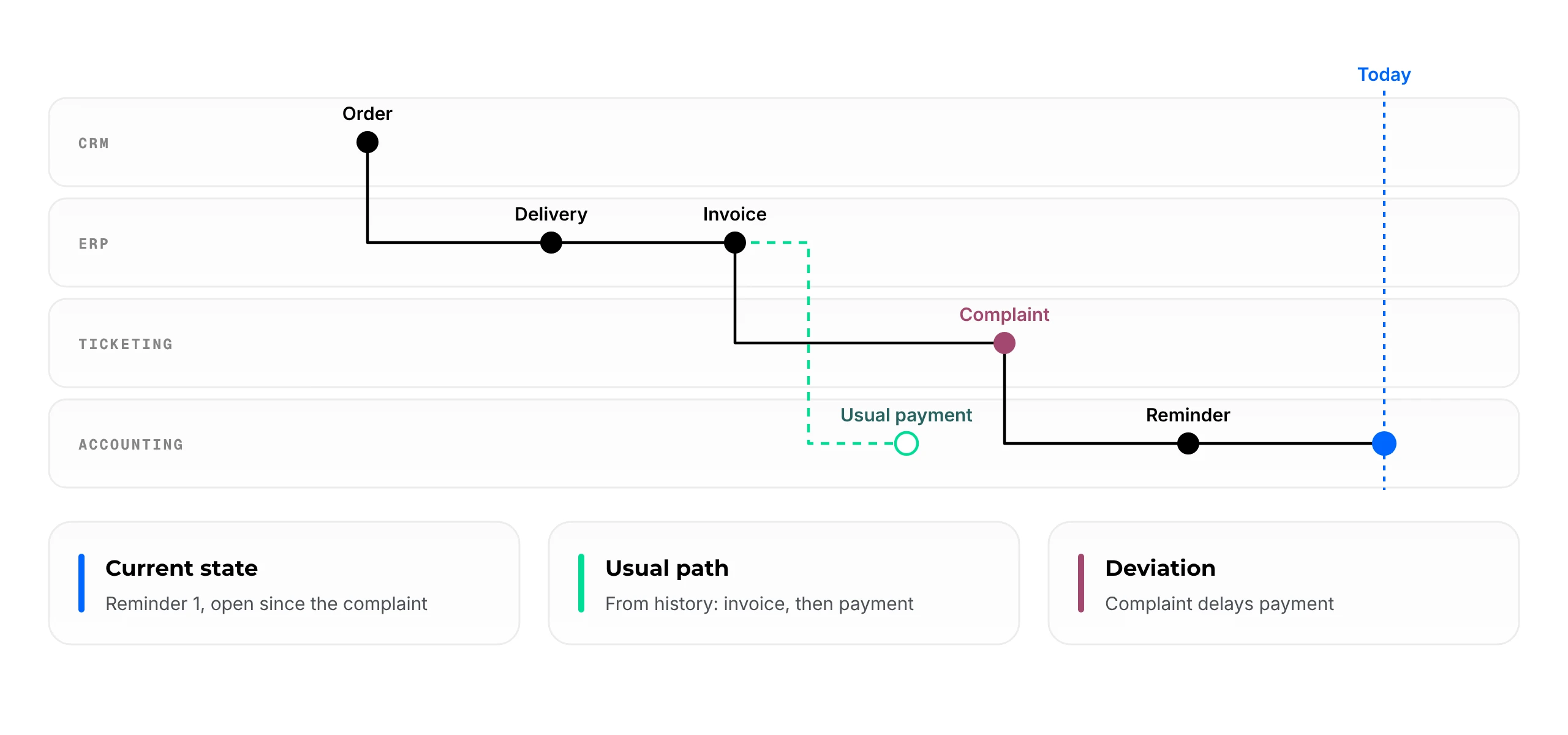
For the process twin and the ontology to fit together, the twin has to be object-centric. In practice, one order leads to several deliveries, one invoice bundles line items from several orders, and one payment clears several invoices. Object-centric process mining maps these relationships instead of hanging everything on a single case ID. That way, ontology and process twin work with the same business objects, the ontology with their meaning, the twin with their history.
An example (fictional, for illustration): A sales rep asks the AI assistant whether she can offer an existing customer 60-day instead of 30-day payment terms. Company knowledge supplies the master agreement and the policy on when finance has to sign off. The ontology shows that the customer belongs to a corporate group whose combined open items are close to the credit limit. The semantic layer delivers DSO and credit limit based on one consistent definition. The process twin shows that the customer regularly paid after the due date last year, that two invoices are in dispute, and that the customer’s complaints often lead to late payment. The result isn’t a guess but a recommendation with evidence that finance can review and approve.
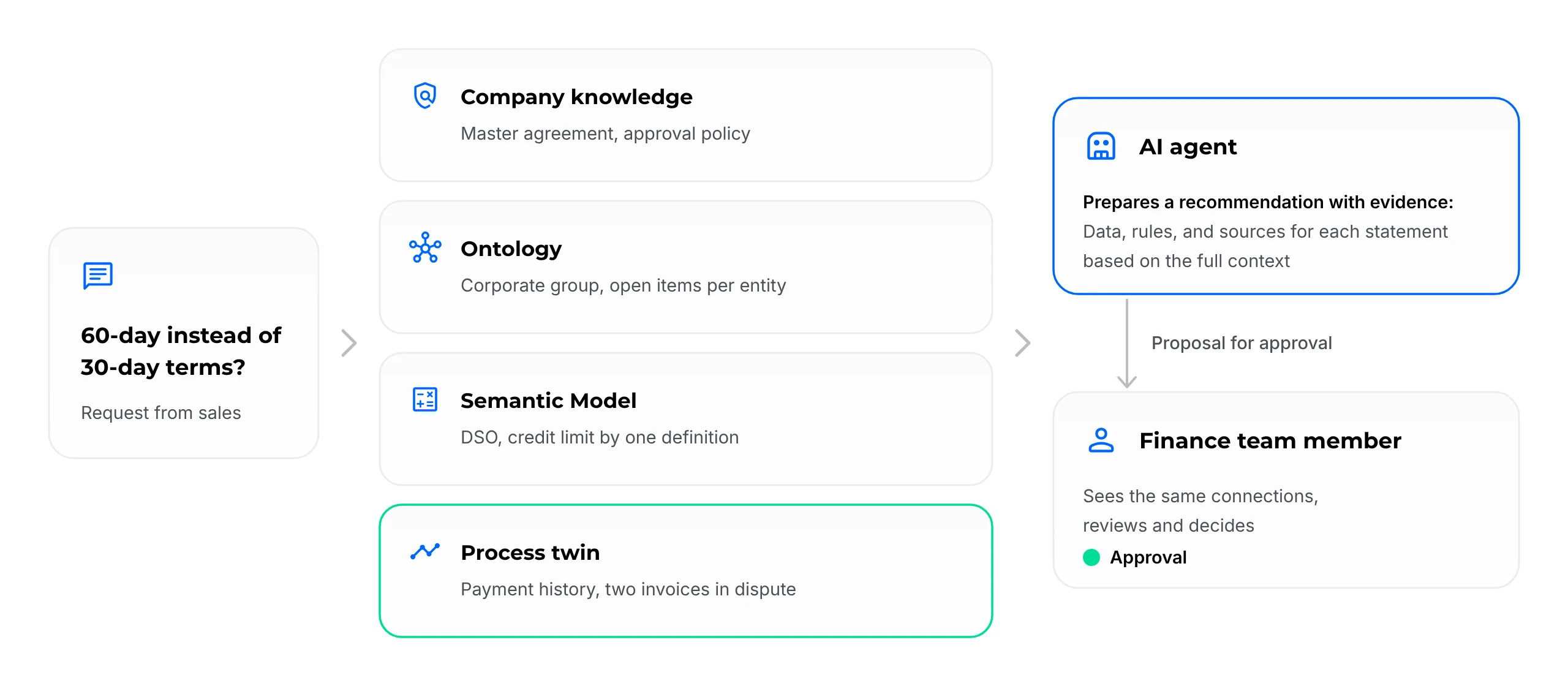
Without process context, an agent sees a snapshot. With it, the agent sees a sequence it can put into perspective.
Why does a context layer need process intelligence?
Company knowledge and semantics can be built with knowledge bases, data catalogs, and semantic layers. What these tools don’t deliver is how processes actually unfold. That takes process intelligence, meaning process mining connected to business objects, metrics, and rules. It reconstructs from the event data of operational systems how cases really run, keeps the process twin current, and links it to the same objects and metrics the ontology and semantic layer define.
Only then does a semantic layer become a context layer that AI agents can work with day to day. They spot which case needs attention, put it in context, and back their recommendation with the actual sequence of events rather than a snapshot.
Where should a context layer live?
Gartner places the context layer within data and analytics infrastructure.3 That raises an architecture question. Does context live on the data platform the company already runs, or in a single vendor’s environment?
On the company’s own platform, existing roles and policies continue to apply. Metrics have the same definition for BI and AI, and the platform’s AI services work with the same context as reporting and planning. The context layer becomes part of the data and AI strategy the company is already pursuing. If context lives in a separate environment instead, a second version of the truth emerges next to the data platform, with its own governance, its own copies, and its own bill.
How does mpmX put context engineering into practice?
An AI agent reads data. A Digital Worker knows your business. That difference is what mpmX, a platform for Agentic Process Intelligence, is built on. The mpmX Context Layer brings the three types of context together in one layer:
- Digital Process Twin: Object-centric process mining assembles event data from source systems such as SAP and Oracle into a living model of every process.
- Ontology and Semantic Model: Objects, relationships, rules, and metrics are defined once and apply equally to people and AI agents.
- Company knowledge: Policies, contracts, and process descriptions feed in as rules.
mpmX runs natively on Snowflake, Databricks, BigQuery, or Qlik, so it fits the data and AI strategy the company already has in place. Data is read where it lives, not duplicated. Existing permissions and policies stay in force. External AI agents connect to mpmX via MCP, and the company chooses its own language model and client.
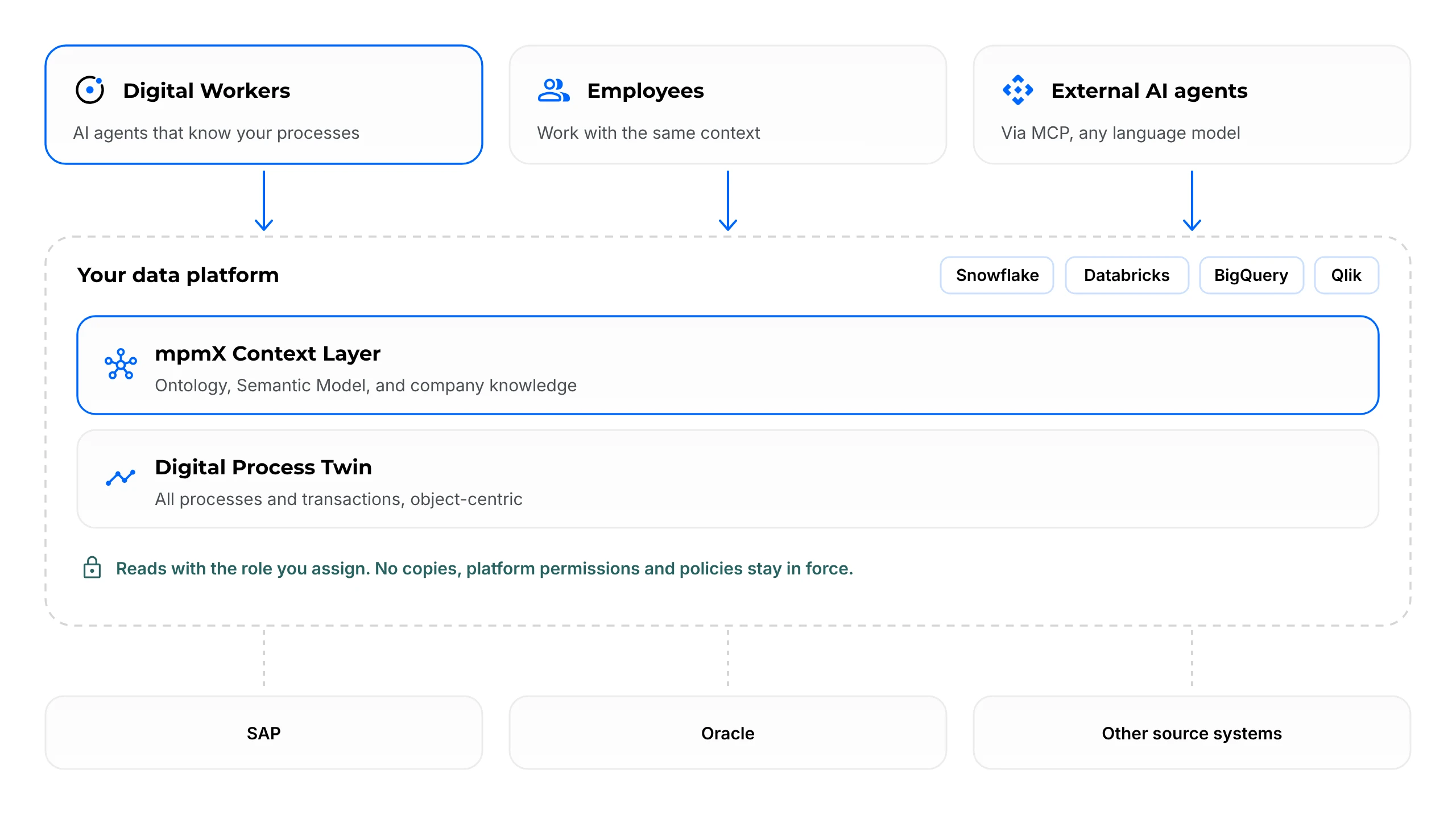
That’s what sets the mpmX Context Layer apart from common approaches. Data catalogs and data platforms provide semantics but no process twin. Process intelligence solutions provide process context but often keep it in a separate environment next to the data platform. mpmX brings both together on the company’s own platform. Because context is defined once, every new use case builds on it, and AI agents query it instead of working it out again with every request. That lowers costs in both the build and day-to-day operations.
When an AI agent works through the mpmX Context Layer, it becomes a Digital Worker. It spots what needs attention, checks it against the company’s context, and proposes what to do. A person makes the call, and mpmX logs every action with its context, rule, and approval.
To see how the Context Layer is built in detail, visit the AI Context Layer page.

- [1] Simon Willison: Context engineering, June 27, 2025, quoting Tobi Lütke and Andrej Karpathy. https://simonwillison.net/2025/Jun/27/context-engineering/
- [2] Anthropic: Effective context engineering for AI agents, September 29, 2025. https://www.anthropic.com/engineering/effective-context-engineering-for-ai-agents
- [3] Gartner: Gartner Says Lack of Semantics Causes Inaccurate AI Agents and Wasted Spending, May 11, 2026. https://www.gartner.com/en/newsroom/press-releases/2026-05-11-gartner-says-lack-of-semantics-causes-inaccurate-artificial-intelligence-agents-and-wasted-spending
- [4] Forrester, Boris Evelson and Indranil Bandyopadhyay: The Next Evolution Of AI Will Rely On Context Layers, August 20, 2026. https://www.forrester.com/blogs/the-next-evolution-of-ai-will-rely-on-context-layers/
- [5] Gartner: Gartner Predicts Over 40% of Agentic AI Projects Will Be Canceled by End of 2027, June 25, 2025. https://www.gartner.com/en/newsroom/press-releases/2025-06-25-gartner-predicts-over-40-percent-of-agentic-ai-projects-will-be-canceled-by-end-of-2027
- [6] Chroma Research: Context Rot. How Increasing Input Tokens Impacts LLM Performance, July 14, 2025. https://trychroma.com/research/context-rot
- [7] Atlan: Ontology vs. Semantic Layer. What Data Teams Need in 2026. https://atlan.com/know/ontology-vs-semantic-layer/
- [8] Merge: What is a company brain? https://www.merge.dev/blog/what-is-a-company-brain-how-it-gives-enterprise-ai-company-context

More Articles
Dive in and discover a world where every process tells a story. Turn data into your advantage – unleash its potential with Process Mining andtransform your processes into success stories.
mpmX and Bizzdesign Partner to Integrate Process Intelligence and Enterprise Transformation


When is Process Mining useful?

Value Stream Mapping with Process Mining
Process Mining that fits your organization

