


Fighting Supplier Price Increases with Facts: How AI Agents Support Procurement

“Due to persistently high costs for steel, energy, and logistics, we are raising the unit price by 7.5%, effective January 1.” Letters like this are landing in procurement departments everywhere, especially in manufacturing. The reasoning sounds plausible. Energy, wages, and raw materials have all become more expensive.
Whether it holds up in a given case can be checked. The facts, however, are scattered: price history and order volumes in the ERP, supplier ratings in the SRM system, agreed prices in framework contracts, index trends with external data providers. Pulling all of that together for every request takes hours.
Most procurement teams are capable, but stretched thin by day-to-day work. So increases often get accepted, at least in part, simply because there is no time to build a solid counter-calculation. That groundwork is exactly what you can now hand to an AI agent, provided it knows the process context.
How procurement contributes to free cash flow
Procurement affects free cash flow in two places: costs in the P&L and the timing of payments. With price increases, the focus is on costs.
Price hits cost of goods and EBIT, and it does so for good. A quick example: on a material with an annual spend of €2 million, an accepted 7.5% increase costs around €150,000 a year, every year.
Beyond the price itself, there are other cost levers: gaps between agreed and invoiced prices, lost cash discounts, and duplicate invoices. Cash discounts are especially direct: 2% for payment within 10 days works out to an annualized return of more than 36%. Every discount missed comes straight off the bottom line.
With price increases, time is a factor too. Every week an unjustified increase goes unchallenged costs margin, a classic cost of delay. What usually stands in the way of a fast, well-founded response is a lack of transparency.
Without process context, even the best agent is guessing
BI reports show spend, purchase prices, and often a supplier rating. They do not show whether a price increase is justified. That takes a multi-year comparison with cost drivers and process-based supplier performance. Does the supplier confirm orders on time? Does it meet delivery dates? Do deliveries match orders, and do invoices match goods receipts?
An AI agent working directly on raw data is of little help here. It sees tables, not the business. It guesses which order belongs to which invoice, knows nothing about contracts, and has no idea what it is allowed to propose.
mpmX supplies the missing context. The platform connects to SAP, other ERP systems, or an SRM system and models purchase orders, deliveries, invoices, and materials as one connected system in a digital process twin. The mpmX Context Layer adds rules and consistently defined KPIs. Combined with external market data such as price indices, that gives you the knowledge a sound assessment needs.

Only with this context does an agent become a Digital Worker: it knows your business instead of guessing. The language model handles the writing and summarizing. The facts come from the process data.
The Defender Agent: from supplier request to negotiation brief
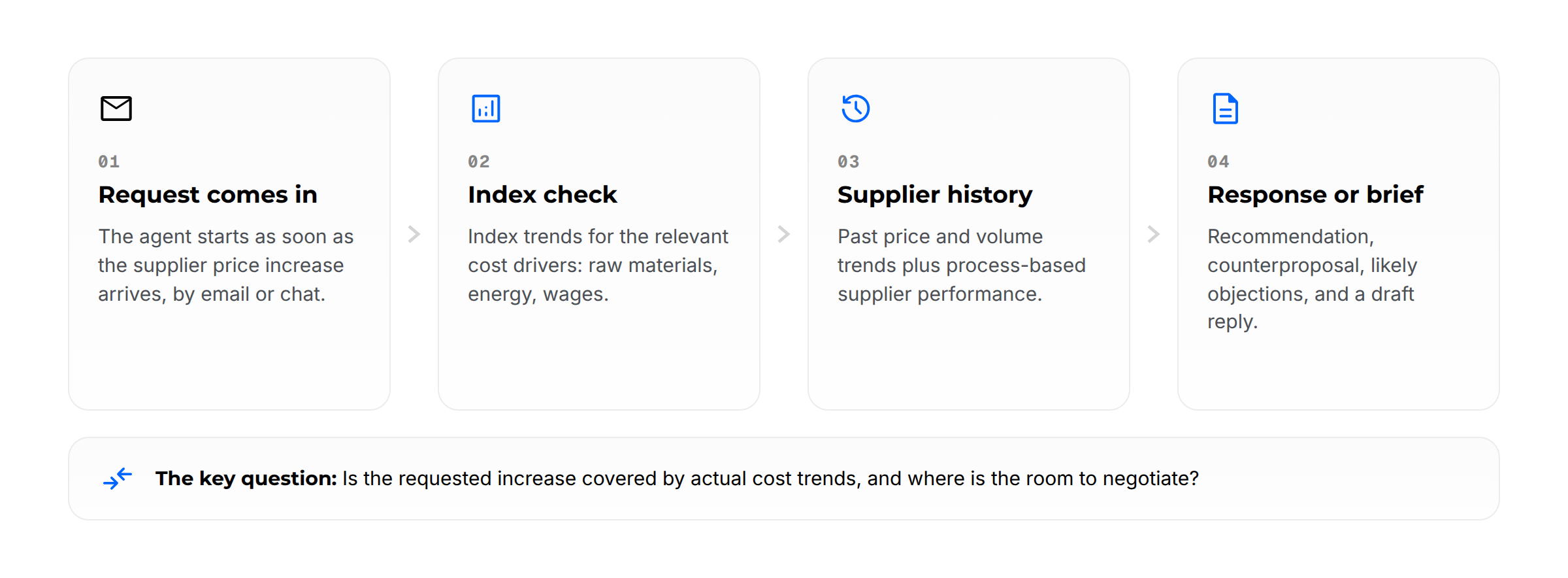
The Defender Agent is an mpmX Digital Worker for procurement. It checks supplier price increases and prepares the response. It answers one question: is the requested increase covered by actual cost trends, and where is the room to negotiate? It works in four steps.
- The request comes in: The buyer forwards the supplier's email to the agent or pastes the text into the chat, for example after a phone call. The agent extracts the request from the unstructured text and maps it to the material and supplier.
- Index check: It compares the request with index trends for the relevant cost drivers, namely raw materials, energy, and wages.
- Supplier history: It analyzes past price and volume trends, checks whether the material is also sourced from other suppliers, and factors in process-based supplier performance.
- Response or brief: It delivers a recommendation with the reasoning behind it, a counterproposal, the objections the supplier is likely to raise along with rebuttals, and a draft reply.
The agent does not negotiate on its own and does not send emails. The buyer receives the proposal, reviews it, and decides whether to reply in writing or take it to a conversation. Because the analysis is ready within minutes, procurement can respond before the increase takes effect. Based on customer projects, this one agent alone saves one to three hours per case, depending on the complexity of the supplier and the material.
A typical case, worked through
A component supplier announces a 7.5% increase on a galvanized carrying roller for the new year, citing steel, energy, and logistics.
In the short term, the request looks reasonable: the relevant cost indices have recently risen by 7.2%. But the agent looks at the price over several years. Since 2024, the roller's price has gone up 10.1%, while the cost indices rose just 1.2% over the same period. In other words, the supplier has long since priced in its cost increases, including some that have since reversed.

The recommendation is therefore to reject the request. The brief includes a counterproposal and anticipates the obvious objection that costs have gone up, answering it with the multi-year trend. It also comes with a draft reply to the supplier's key account manager.
In the second case, a supplier asks for 6% more on a different material. Since the last price agreement, however, the cost indices for this part have fallen by 14.78%. Here, procurement is no longer on the defensive. It has room to push for a price cut. The agent backs this up with a counter-calculation broken down by cost component: material, contract manufacturing, energy, freight, and other costs.

Sample calculations, illustrative figures.
More cost levers in procurement
The same digital process twin also shows where procurement is losing money beyond price increases. One example is gaps between agreed and invoiced prices. The twin lines up agreed prices, order prices, and invoice prices over time, making it visible where suppliers charge more than the framework contract allows, a pattern often called contract leakage.
Another is lost cash discounts. The causes usually lie in the process, rarely with the supplier: invoices are only entered after the discount period has expired, approvals get stuck in loops, or price variances block an invoice until the deadline has passed. The twin shows in which company code, with which supplier, and in which purchasing group this happens, and puts a number on the loss.
There are more Digital Workers for these patterns that work alongside the Defender Agent in procurement:
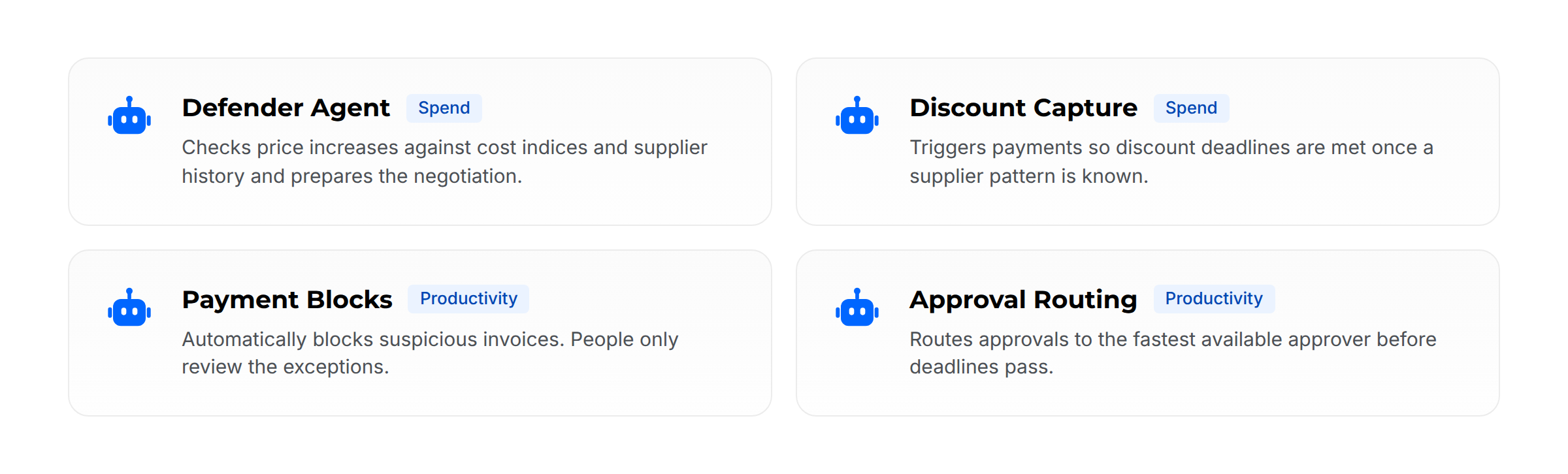
- Discount Capture triggers payments so that discount deadlines are met, as soon as a supplier's pattern is known.
- Payment Blocks automatically blocks suspicious invoices. People only review the exceptions.
- Approval Routing sends approvals to the fastest available approver, so deadlines are not missed because of a full inbox.
An added effect: working capital
Beyond costs, procurement also affects cash flow, through the timing of payments. A common pattern is invoices paid days before they are due, without taking the early-payment discount. The money leaves earlier than necessary, with nothing in return.

Payment timing determines Days Payable Outstanding (DPO) and with it the cash conversion cycle. Five extra days of DPO release around €4.1 million in cash per €300 million of procurement spend, without changing a single contract. Here too, Digital Workers and analyses can be built directly on the digital process twin by chatting with the language model of your choice, such as Claude. One example is a DPO monitor that tracks early payments without discount against an industry benchmark.
Walking into negotiations with facts
Suppliers will keep citing rising costs to justify higher prices. What matters is how fast and how well-founded procurement's response is. Digital Workers take on exactly the work there is no time for in day-to-day business. They check every request against cost indices and supplier history, uncover gaps between agreed and invoiced prices as well as missed cash discounts, and deliver solid arguments in minutes instead of hours. People still lead the negotiation, but they walk in with facts. That has a direct effect on margin and free cash flow.
Process context is what makes this possible. mpmX builds it directly on the infrastructure you already have, whether Snowflake, Databricks, BigQuery, or Qlik, without copying data and with your existing governance in place. That is why first results come within a few weeks. To see where your procurement processes cost margin and tie up cash, explore Process Intelligence for Procurement.

More Articles
Dive in and discover a world where every process tells a story. Turn data into your advantage – unleash its potential with Process Mining andtransform your processes into success stories.

When is Process Mining useful?


Value Stream Mapping with Process Mining

Toolbox automation: 4 basic tools you need to automate business processes
Process Mining that fits your organization

